







Enterprises are eager to harness the power of AI and Large Language Models (LLMs), but too often they deploy them without fully understanding performance risks. Inconsistent outputs, hallucinations, or compliance failures can erode trust and expose enterprises to regulatory or reputational harm.
By establishing a rigorous LLM evaluation framework, geared toward LLM and responsible AI, enterprises can ensure their models are accurate, safe, and aligned with ethical standards and legal frameworks like the EU AI Act, ISO 42001, and the NIST AI RMF. The result: AI applications and LLMs that are reliable, accurate, and tied to enterprise business outcomes.
Why LLM Evaluation Matters
LLM evaluation is a foundation of Responsible AI. It involves testing how well models perform in real-world scenarios, assessing the LLM’s ability to understand and respond to queries, generate coherent text, and provide contextually appropriate answers. This helps businesses identify gaps before deployment or during the application of LLM fine-tuning services.
According to PwC’s 2024 US Responsible AI Survey, only 11% of organizations have fully implemented responsible AI capabilities, leaving the vast majority exposed to risks of bias, inaccuracy, and compliance violations. Without evaluation, enterprises risk releasing systems that harm user trust and undermine adoption.
Critical Evaluation Metrics for Enterprises
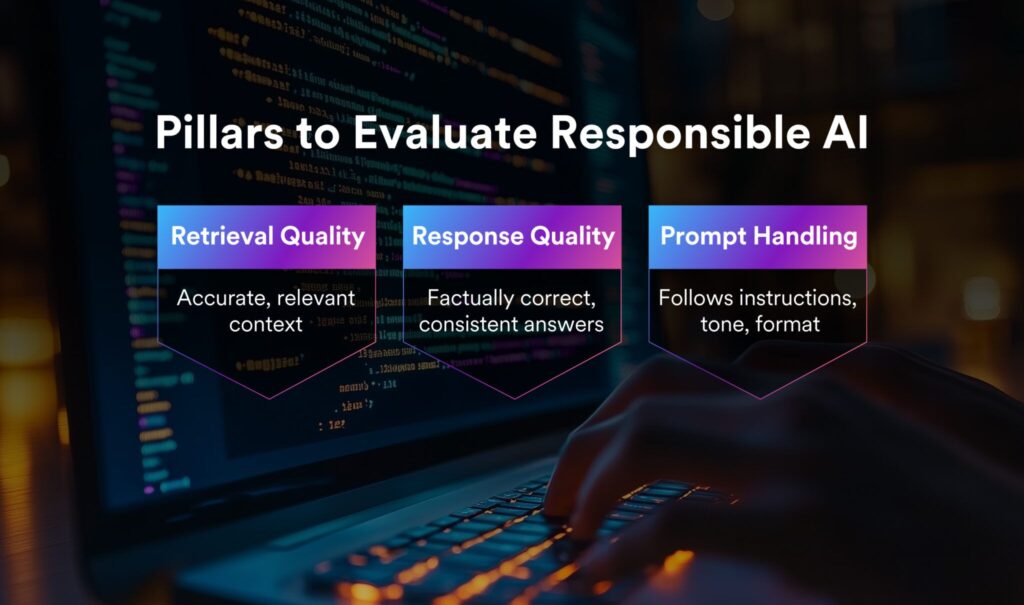
1. Retrieval Quality
Measures how effectively the model retrieves relevant, complete, and accurate context needed to support the output. This is especially important in Retrieval-Augmented Generation (RAG) applications, where external knowledge is used to ground answers.
Example: If the prompt is “What are the eligibility requirements for our premium customer support tier?”, the model should retrieve the correct section from the internal policy documentation, not outdated or unrelated documents.
2. Response Quality
Assesses the clarity, accuracy, and completeness of the LLM’s final output. High response quality ensures that the model answers the question correctly, stays relevant, and supports ongoing multi-turn conversations with consistency.
Example: If the prompt is “Summarize the client’s Q2 feedback and highlight top complaints,” the LLM should produce an accurate, concise summary based on retrieved CRM notes—covering all key complaints without hallucinating issues.
3. Prompt Handling
Measures how well the model understands and adheres to the user’s instructions, tone, and formatting constraints. This is crucial for enterprise workflows involving report generation, compliance summaries, or structured content creation.
Example: If the prompt is “Write a 3-bullet executive summary of this audit report in a neutral tone—no opinions,” the model should return three concise, factual bullets without adding commentary or emotional language.
Business Impact of LLM Evaluation
Organizations that adopt robust evaluation frameworks build stronger foundations for innovation. Reliable LLMs reduce legal exposure, protect brand reputation, and boost user adoption. They also empower teams to scale use cases with confidence, from internal copilots to customer-facing assistants.
Research shows enterprises that embed trust into AI design see higher customer satisfaction and greater long-term ROI (PwC, 2024). LLM Evaluation, therefore, is not optional for successful LLM and responsible AI deployment. It is the first step toward AI systems that are both effective and ethical.
LLM evaluation enables enterprises to move beyond experimentation toward accountable, trustworthy AI. By embedding strong evaluation pipelines, leaders can ensure their AI investments deliver real value while meeting regulatory and ethical standards.
At Orion Innovation, we help enterprises build and operationalize Responsible AI through scalable governance frameworks along with custom LLM fine-tuning services and enterprise-ready APIs.
Author
Ashwyn Tirkey
Services