







AI is the most transformative technology shaping the world around us—including how enterprises will operate, compete and innovate.
Enterprises are no longer sitting on the sidelines.
Last year was marked by experimentation and proof-of-concepts—but now, organizations are moving toward real-world implementation. Most are actively exploring how AI can drive productivity, enhance operational efficiency, and unlock new products and services.
AI is moving at a pace faster than most enterprises can comprehend. Yet, despite the headlines, we’re still in the early stages of AI maturity. As illustrated below, we’ve moved past the Conversational AI phase—where interacting with tools like ChatGPT became mainstream—and we are now entering the Reasoning phase, where AI demonstrates cognitive capabilities and logical reasoning. With the rise of AI Agents, we’re beginning to see the early emergence of Autonomous AI, where agents can execute complex, long-running workflows with minimal human input.
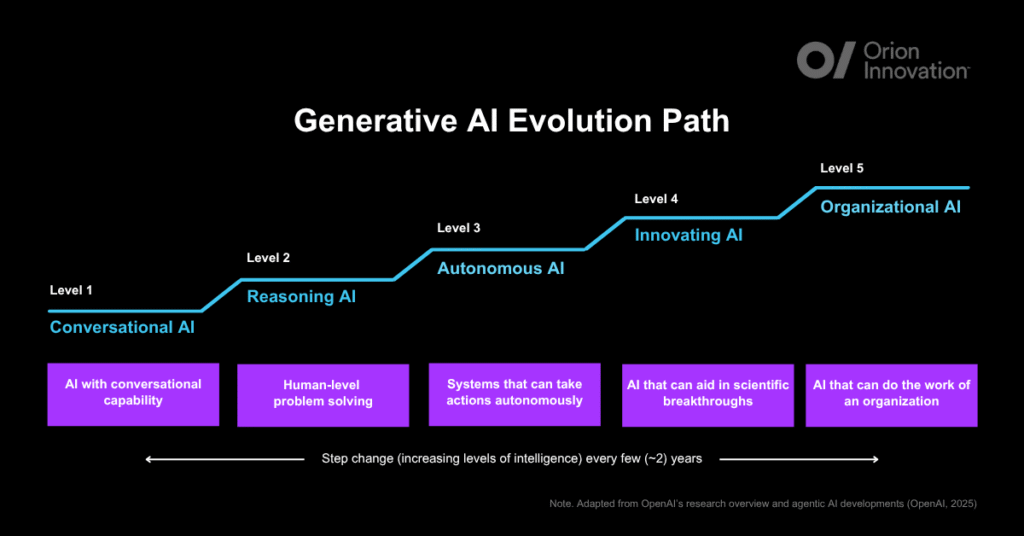
Every year or two brings a paradigm shift, and this trend shows no signs of slowing. In the near future, AI could extend into creative thinking and even contribute meaningfully to R&D. This chart is not to show a final destination—but it’s an ongoing evolution that will continue to unfold in the coming years.
AI will become more capable, more autonomous, and more integrated into the fabric of our daily lives, including the enterprise. Here are the key trends shaping AI’s evolution from experimentation to enterprise-scale deployment.
AI Models are Getting Smarter
AI models are the “brains” behind the AI system we use today, and these brains are getting significantly smarter, faster, and multi-modal.
Reasoning Model
Reasoning capability has been the biggest innovation with models in recent months. Five of the top 10 models are now reasoning models. A Reasoning model is a type of AI model designed to perform multi-step logical thinking, inference, or problem-solving beyond simple pattern matching or recall.
Just a couple of years ago, we had to provide AI systems with carefully structured questions and lots of context to get decent results. Today, models are reasoning on their own, generating structured outputs, and performing increasingly complex tasks with very little input.
One thing to note is the enterprise inference costs will go higher with reasoning models as they require more compute, memory, and time to handle multi-step logical processes and longer context windows.
Regardless, the scope of how and where we’ll use models will continue to expand.
Read the full article at aijourn.com.
Services
