







Financial crime is evolving faster than traditional controls can respond. A single missed incident can result in millions of dollars in losses, regulatory fines, and irreversible reputational damage.
Leaders must adopt solutions that are proactive, intelligent, and capable of scaling. Agentic AI promises just that: as the next generation of Large Language Models (LLMs), they can reason, plan, and act, enabling faster investigations.
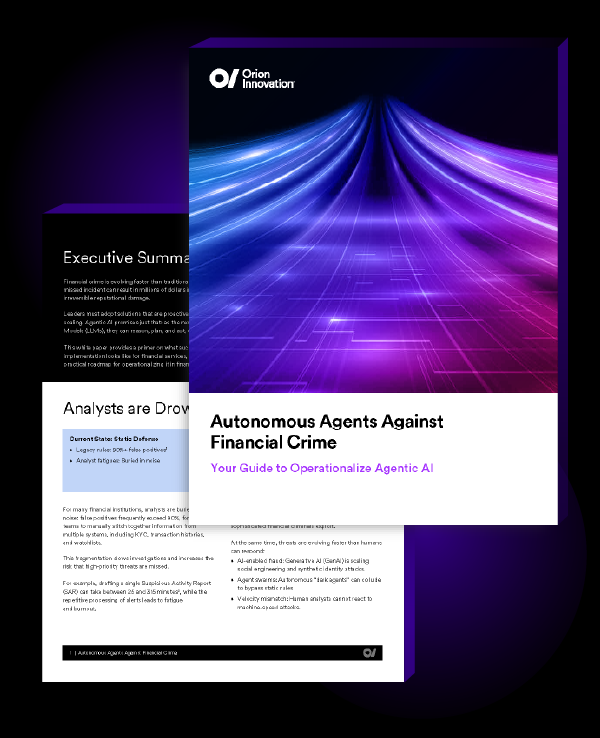
This white paper, written by our Head of GenAI practice, provides a primer on what successful Agentic AI implementation looks like for financial services, plus a practical roadmap for operationalizing it in financial crime prevention.
Download our white paper to learn about:
- What specialized financial services AI Agents look like in action
- Concrete investigative workflows powered by Agentic AI
- A roadmap to operationalizing Agentic AI and where to start
- A real-world success story in the enterprise
- How to measure impact of Agentic AI
Learn more about our AI offerings and Financial Services expertise.
What Enterprise Leaders Are Asking
1. What is Agentic AI and how does it differ from the AI we already use?
Most AI deployed in financial crime today is reactive; it flags anomalies based on static rules. Agentic AI operates in a continuous perceive–reason–act cycle: it collects and interprets data, evaluates patterns, and then executes actions or escalates to humans, without waiting to be prompted.
2. Will autonomous agents replace our compliance analysts?
No. The model is human-on-the-loop, not human-out-of-the-loop. Agents handle high-volume, routine tasks—triaging alerts, enriching cases, drafting SAR narratives—so analysts can focus on complex, judgment-driven decisions.
3. How do we ensure agents meet our regulatory and audit requirements?
Governance is built in from the start. Every agent decision is recorded through chain-of-thought reasoning, creating a fully auditable trail. Systems are designed for alignment with frameworks including the EU AI Act, and explainable AI ensures regulators can trace the rationale behind every action taken or not taken.
4. We can’t share customer data across institutions. How does cross-institution detection work?
Fully Homomorphic Encryption (FHE) allows agents to compute on encrypted data, meaning patterns and risks can be identified across institutions without any raw personal data being exposed. This makes collaborative detection of cross-border money laundering and coordinated fraud possible while remaining fully compliant with GDPR and equivalent regulations.
5. Where should we start if we want to pilot Agentic AI for financial crime?
Start with low-risk, high-volume use cases where the operational pain is greatest: AML transaction monitoring and SAR generation are natural entry points. Early wins build confidence, demonstrate ROI, and create the data and governance foundations needed before agents take on more complex, multi-system workflows.
Author
Ashwyn Tirkey
Industries
Banking, Financial Services & Insurance
Services
Artificial Intelligence
Download the White Paper
"*" indicates required fields
Author
Ashwyn Tirkey
Industries
Banking, Financial Services & Insurance
Services