







Enterprise data modernization has long been trapped in a cycle of large, brittle engineering projects: migrate the warehouse, re-platform the lake, rebuild the semantic layer. Each initiative consumes years of effort, only to leave enterprises bracing for the next one. The result is a data estate that is perpetually catching up, never ahead.
A fundamentally different pattern is now emerging. Across Microsoft Fabric, Snowflake, Databricks, GCP, and AWS, data platforms and AI capabilities are converging into autonomous ecosystems. They are now able to adapt continuously to new sources, policies, and business demands rather than waiting for the next multi-year program.
Enterprises that seize this shift will move from static data factories, where every change carries significant engineering overhead, to agent-orchestrated ecosystems.
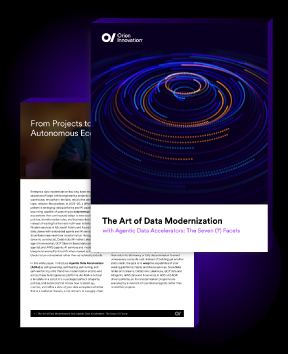
This white paper, written by our Practice Head of Data & Analytics, dives deep into the concept of Agentic Data Accelerators (ADAs) and the Agentic Data Squad (ADS). Learn how they form a practical, governance-first framework for orchestrating modernization across your entire heterogeneous data landscape.
Download our white paper to learn about:
- The “sleeper knights” agentic model
- Seven facets of ADAs
- The A–B–C–D Semantic Model in Detail
- Domain-Specific Small Language Models (DSLMs) and its impact
- How to start your Agentic Data Modernization journey
Learn more about our Data & Analytics offerings.
What Enterprise Leaders Are Asking
- What are Agentic Data Accelerators?
ADAs are self-governing, self-healing, self-tuning units that drive data modernization end-to-end across your technology platforms. Unlike a template or a script, an ADA is a packaged pattern of agents, policies, and behaviors that knows how to stand up, monitor, and continuously refine a slice of your data ecosystem.
- Do we need to rip out our existing platforms to adopt this approach?
No. Agentic Data Accelerators are designed to wrap your existing investments, not replace them. Each platform’s storage, compute, and metadata capabilities become building blocks that agents orchestrate. The goal is to make what you already have work as a coordinated system, not to trigger another forklift migration.
- How are ADAs different from the automation and orchestration tools we already use?
Traditional orchestration tools execute predefined pipelines. ADAs go further: they are self-governing units that monitor, adapt, and refine a slice of your data ecosystem continuously. They detect anomalies, enforce policies, update semantic state, and self-decommission when their work is done, without waiting for an engineer to intervene or a project to be scoped.
- What does this mean for our data engineering team?
Their role shifts from building and maintaining exhaustive pipelines and semantic models to designing the guardrails: curating metadata, defining domain contracts, and codifying policies that agents enforce at scale. Repetitive integration work is absorbed by ADAs, freeing engineers to focus on higher-value architecture and governance work.
Author
Paul Kulkarni
Download the White Paper
"*" indicates required fields
Author