







Enterprises are generating more data than ever before, yet many organizations still struggle to turn that data into real business value. Traditional data architectures were designed for slower reporting cycles and centralized analytics teams, not for real-time AI-driven decision-making.
Modern data strategies in 2026 are shifting toward real-time processing, self-service access, and AI-ready architectures. The impact is profound: organizations that modernize their data foundations can move faster, empower more teams, and unlock new capabilities powered by advanced analytics and AI.
The New Reality of Enterprise Data in 2026
Over the past decade, the role of data in the enterprise has transformed dramatically. What was once primarily used for reporting and dashboards is now the foundation for AI systems, digital platforms, and intelligent automation.
In many organizations today, data is no longer confined to a central BI team. Instead, it is embedded across the organization, supporting everything from predictive analytics to autonomous decision-making systems.
Modern data environments prioritize:
- Real-time processing instead of batch reporting
- Self-service analytics rather than IT-gated access
- Predictive and prescriptive insights instead of descriptive dashboards
- AI-ready architectures designed to support agents, automation, and machine learning
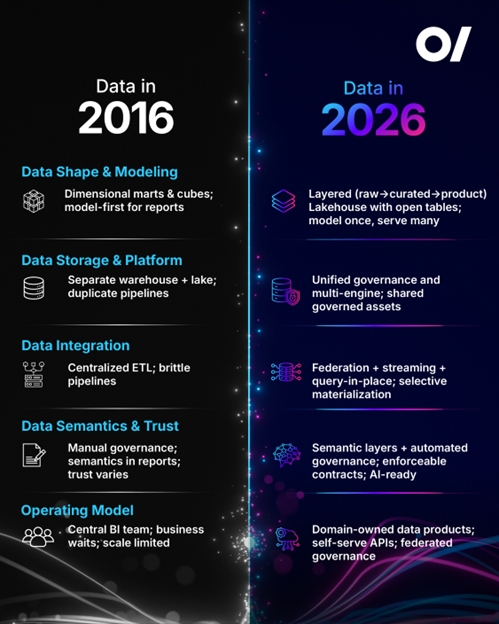
As highlighted in the reference framework, enterprise data strategies are evolving from batch dashboards and on-premise silos toward real-time streaming platforms and agent-ready data ecosystems.
This shift reflects the growing demand for faster insights and more scalable analytics capabilities across organizations.
From Traditional Data Models to AI-Ready Architectures
One of the most significant changes in modern data strategies is the evolution of how data is structured and modeled.
Earlier enterprise architectures often relied on dimensional data marts and tightly structured reporting models designed specifically for BI tools. These systems were effective for historical reporting but struggled to support the dynamic workloads required for machine learning and AI.
Modern architectures now rely on lakehouse platforms combined with open table formats and layered data models, allowing organizations to structure data once and serve it across multiple workloads.
This layered approach, often described as raw, curated, and productized data layers—allows teams to reuse data assets across analytics, AI models, and operational applications. The result is a more flexible data ecosystem where data products can power multiple use cases simultaneously.
Open table formats have also become a critical inflection point for enterprise data platforms. They enable capabilities such as schema evolution, time travel, and transactional consistency directly on cloud storage, making it possible to manage large-scale data assets with greater reliability and governance.
Unified Data Platforms Replace Fragmented Architectures
Another defining shift in 2026 is the move away from fragmented data stacks.
Historically, organizations maintained separate systems for data warehouses and data lakes, which often resulted in duplicated pipelines, inconsistent data definitions, and operational complexity.
Modern data architectures are increasingly built around unified lakehouse platforms with shared governance and multi-engine processing capabilities.
These platforms allow organizations to support business intelligence, machine learning, and AI workloads on a common foundation. By reducing redundant data copies and aligning governance across environments, enterprises gain better visibility, stronger compliance controls, and more efficient data operations.
This consolidation also enables faster innovation because teams can access governed datasets without rebuilding pipelines or waiting for centralized data teams.
Data as a Product: A New Operating Model
Perhaps the most transformative shift in enterprise data strategies is the move toward data as a product.
Instead of relying solely on centralized BI teams to curate datasets, organizations are adopting domain-based ownership models where business teams are responsible for creating and maintaining their own data products.
This approach is supported by federated governance frameworks and self-service platforms, enabling data to be delivered as APIs or reusable data products across the organization.
Data contracts and semantic layers also play a crucial role in this model. They provide the context, definitions, and governance needed to ensure that data remains trustworthy and usable across teams. As a result, enterprises can scale analytics and AI initiatives more efficiently while maintaining consistent data quality and governance standards.
The Business Impact of Modern Data Platforms
Modern data architectures do more than improve technical efficiency. They unlock new strategic capabilities.
Organizations that adopt AI-ready data platforms gain several advantages:
• Faster access to insights through real-time analytics
• Greater accessibility with embedded self-service tools
• More advanced decision-making powered by predictive and prescriptive AI
• Scalable data ecosystems that support AI agents and automated systems
These capabilities enable companies to move beyond traditional reporting and toward truly data-driven operations.
In a world where AI systems depend on high-quality, well-governed data, the strength of an organization’s data foundation will increasingly determine its ability to compete.
Get Your Data Ready for AI
Enterprise data strategies have evolved from centralized reporting systems into dynamic, AI-ready platforms that power real-time insights and intelligent automation. Organizations that modernize their data architectures; embracing lakehouse platforms, unified governance, and data-as-a-product operating models, position themselves to innovate faster and scale analytics across the enterprise.
At Orion, we help organizations modernize their data foundations and build AI-ready platforms that deliver real business value. Learn more about our Data & AI services and how we help enterprises transform data into a strategic advantage.
Author