







At Orion, we’re exploring how AI tools are transforming the way design teams and organizations operate through advanced experience design services. Discover how these tools are applied in practice, with real-world insights from our award-winning Experience Design team.
In Experience Design (XD), research is the foundation of creating products and services that resonate with users. It’s the phase where we uncover user needs, identify pain points, and gather insights that guide design decisions. However, traditional research methods can be time-intensive, resource-heavy, and difficult to scale—challenges that can slow down a project and impact its overall efficiency.
This is where AI tools come into play. By automating repetitive tasks, synthesizing large datasets, and providing actionable insights, AI tools are revolutionizing how experience design research is conducted. For design teams or organizations looking to streamline their processes, these tools offer a way to deliver faster, more accurate results while maintaining the highest standards of quality.
Let’s explore three AI-powered tools, Perplexity, Notably.ai, and Maze, that can transform the research phase of your XD project. Discover their capabilities, use cases, and how they can be integrated into a cohesive workflow.
In this article, we’ll discuss:
- The Role of AI in Experience Design Research
- Perplexity: Accelerating Contextual Research
- Notably.ai: Simplifying Qualitative Data Analysis
- Maze: Automating Usability Testing
- Sample Workflow: Integrating AI Tools
- AI Challenges and Considerations
The Role of AI in Experience Design Research
AI tools are increasingly becoming indispensable in XD research for several reasons:
- Efficiency: They automate time-consuming tasks like transcription, tagging, and data analysis
- Insight Generation: AI excels at identifying patterns and trends in both qualitative and quantitative data
- Scalability: Remote and automated testing capabilities allow for larger participant pools without additional overhead
- Collaboration: Centralized data platforms enable teams offering user experience design services to work together seamlessly and share findings in real time
Perplexity: Accelerating Contextual Research
Key Features
Perplexity is an AI-powered search tool designed to provide quick answers to complex questions. It pulls information from a variety of sources, such as academic papers, forums, blogs, and presents it in a concise format with transparent citations. Its natural language processing capabilities make it easy to ask nuanced questions and receive targeted responses.
Applications in Experience Design Research
Perplexity is particularly valuable during the early stages of a project when defining the problem space or understanding market dynamics:
- Exploring Trends: Quickly gather insights on industry trends or emerging technologies that could influence user behavior
- Competitor Analysis: Understand what competitors are offering and identify gaps in their solutions
- Interview Preparation: Generate thoughtful user interview or survey questions based on contextual information
Use Case
Suppose you’re working on a project to design an app for remote workers. Before conducting interviews, you use Perplexity to explore how remote work has evolved post-pandemic. The tool provides a summary of key trends, such as the rise of hybrid work models, and links to credible sources for further reading. This foundational knowledge allows you to craft more focused interview questions.
Notably.ai: Simplifying Qualitative Data Analysis
Key Features
Notably.ai is built to streamline the analysis of qualitative data from interviews, usability tests, or surveys. Its features include:
- Automatic Transcription: Converts audio or video recordings into text quickly and accurately
- Tagging and Clustering: Uses AI to tag data points and group them into themes
- Centralized Repository: Stores all research data in one place for easy access and organization
- Collaboration Tools: Facilitates team collaboration by enabling the sharing of insights in real time
Applications in Experience Design Research
Notably excels at turning raw qualitative data into actionable insights:
- Interview Analysis: Automatically transcribe interviews and tag recurring themes or pain points
- Survey Data Synthesis: Organize open-ended survey responses into clusters for easier analysis
- Insight Reporting: Create visually engaging reports for stakeholders with minimal effort
Use Case
Imagine you’ve conducted 15 user interviews about an e-commerce website’s checkout process. Uploading the transcripts into Notably allows the platform to tag recurring themes such as “confusion about shipping options” or “concerns about payment security.” These insights can then be shared with your team as part of a detailed report that informs design decisions.
Additionally, Notably’s AI templates empower businesses to ask targeted questions about their data, making it easier to uncover valuable insights. For example, you can create custom templates to analyze recurring pain points or challenges expressed by stakeholders or customers. The platform then synthesizes these insights into clear, actionable trends.
Maze: Automating Usability Testing
Key Features
Maze is a usability testing platform that integrates seamlessly with design tools like Figma. It enables remote testing of prototypes with minimal setup and provides both qualitative and quantitative feedback. Key features include:
- Prototype Testing: Import high-fidelity prototypes directly from Figma for user testing
- Automated Feedback Collection: Gather data on task success rates, misclicks, time-on-task, and more
- Visual Analytics: Generate heatmaps, path analysis, and click tracking reports
- Sentiment Analysis: Understand user emotions during interactions with your design
Applications in Experience Design Research
Maze simplifies usability testing by making it scalable and accessible for teams delivering experience design services:
- Remote Testing: Conduct unmoderated tests with users anywhere in the world
- Data Visualization: Use heatmaps and interaction paths to identify usability issues at a glance
- Iterative Design Validation: Test multiple design iterations quickly to refine your solution
Use Case
You’ve designed a mobile app prototype in Figma and want to test its navigation flow. Importing the prototype into Maze allows you to set up tasks for users — such as “Find the settings menu.” Maze collects data on success rates, misclicks, and time-on-task while generating heatmaps that show where users interacted most frequently. This feedback helps you identify navigation challenges early in the design process.
Sample Workflow: Integrating AI Tools
The true power of these tools lies in how they complement each other across different stages of the research process. Here’s an example workflow commonly used in user experience design services:
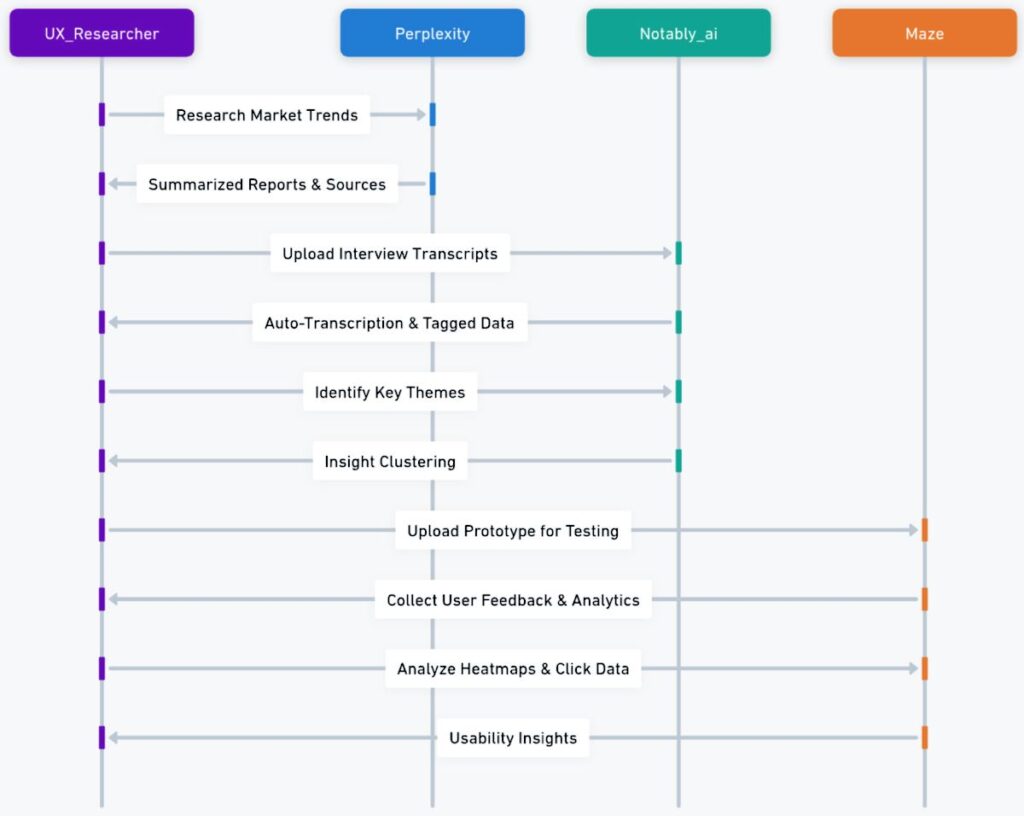
- Start with Perplexity:
- Use it to gather background information about your audience or industry trends
- Define your research objectives based on these findings
- Analyze Data with Notably.ai:
- After conducting interviews or surveys, upload your raw data into Notably for transcription and tagging
- Identify recurring themes or pain points that align with your research goals
- Test Prototypes with Maze:
- Import your Figma prototype into Maze for usability testing
- Analyze visual reports to validate design decisions or identify areas for improvement
This workflow ensures that both qualitative insights (Notably) and quantitative feedback (Maze) are grounded in solid contextual knowledge (Perplexity).
AI Challenges and Considerations
While AI tools offer significant advantages, it’s important to approach them thoughtfully:
- Bias in AI Insights
- Ensure diverse datasets are used to avoid skewed results
- Cross-check AI-generated insights with human judgment for accuracy
- Data Privacy Concerns
- Adhere to privacy regulations like GDPR when handling sensitive user information
- Anonymize participant data whenever possible
- Balancing Automation with Empathy
- While AI can handle repetitive tasks efficiently, human empathy remains critical for understanding user motivations and emotions
Accelerate Your XD Research Process with AI
For design teams looking to deliver high-quality results efficiently, AI tools like Perplexity, Notably.ai, and Maze represent a transformative opportunity. By automating manual tasks, synthesizing complex datasets, and enabling rapid iteration cycles, these tools empower teams to focus on creating exceptional experiences.
Whether you’re exploring market trends with Perplexity, analyzing interview transcripts with Notably.ai, or validating prototypes with Maze, these tools provide a streamlined approach to experience design research that saves time without sacrificing depth or quality. By integrating them into your workflow thoughtfully — and balancing automation with human insight, you’ll be well-equipped to meet project goals while staying ahead in an increasingly competitive landscape.
For decades, Orion Innovation has been helping businesses understand the audiences they serve through strategic user research and innovative experience design services. Explore our offerings.
XD Strategist Dennis Crumbine has over 25 years of leadership and design experience spanning companies including Wayfair, The Nielsen Company, JetBlue, and Microsoft. He has a B.A. in Music & Literature from the Gallatin School at New York University and is also a musician, dog lover, and a very proud father.
Author